What if you are caught in a battle to choose between faith and deception?
The future of the world not only lies upon the shoulders of advanced, booming, innovative technology. It has many other aspects to it. Readers are looking to find their answers at times in Christian science fiction, while at other times they hunt them down in Dystopian fiction.
These are the two popular branches of Christian speculative fiction that imagine the future through a biblical lens. While both genres explore worlds beyond our own, they offer very different reading experiences.
Some stories focus on scientific breakthroughs, artificial intelligence, and space exploration, making them compelling examples of Christian futuristic fiction. Others portray oppressive governments, persecution, and the fulfilment of biblical prophecy, placing them firmly within Christian apocalyptic fiction.
If you are among those who love to dive deep into the world of fiction but simply couldn’t make up your mind between Christian science fiction vs Christian dystopian fiction, here is a look at what both genres of literature have to offer.
What Is Christian Speculative Fiction?
Before comparing the two genres, it’s helpful to understand the broader category they belong to.
Christian speculative fiction includes stories that imagine worlds beyond our world, outside our reality, while remaining rooted in biblical truth. These stories may include futuristic technology, alternate worlds, supernatural events, or imagined societies, but they always explore faith through a Christian worldview.
On the other hand, speculative fiction places spiritual themes at the center of the story. Characters often wrestle with faith, redemption, sacrifice, and God’s purpose while facing extraordinary circumstances.
Both Christian science fiction and Christian dystopian fiction are important branches of this growing genre.
What Is Christian Science Fiction?
Christian science fiction focuses on scientific advancement, space exploration, artificial intelligence, futuristic societies, or advanced technology while remaining grounded in biblical principles.
The story usually asks questions like:
- How should Christians use technology responsibly?
- Can scientific progress replace God?
- What happens when humanity pushes beyond its moral boundaries?
- How does faith remain relevant in an advanced civilization?
Rather than portraying technology as inherently evil, these stories often explore how human choices determine whether innovation becomes a blessing or a danger. There are many examples of popular Christian science fiction books by Marty Gool that include The Day the End Began by Mark E. Fisher and The Sphere of Destiny series by Sigmund Brouwer.
What Is Christian Dystopian Fiction?
Christian dystopian fiction imagines a future where society has taken a dark turn.
Governments become oppressive. Religious freedom disappears. Truth is manipulated. Technology may be used as a tool of control rather than progress. Ordinary believers are forced to choose between safety and faithfulness.
Many of these novels also fit within Christian apocalyptic fiction, especially when they draw inspiration from biblical prophecy or the Book of Revelation.
A Christian end-times novel often falls into this category because it imagines events surrounding the final days while emphasizing God’s ultimate victory. An example of one such work is Left Behind by Tim LaHaye and Jerry B. Jenkins. The book is perhaps the most influential Christian end-times series, following the lives of those left behind after the Rapture as they navigate the Tribulation.
Rather than asking, “What can technology do?” dystopian stories ask, “What happens when society rejects God’s truth?”
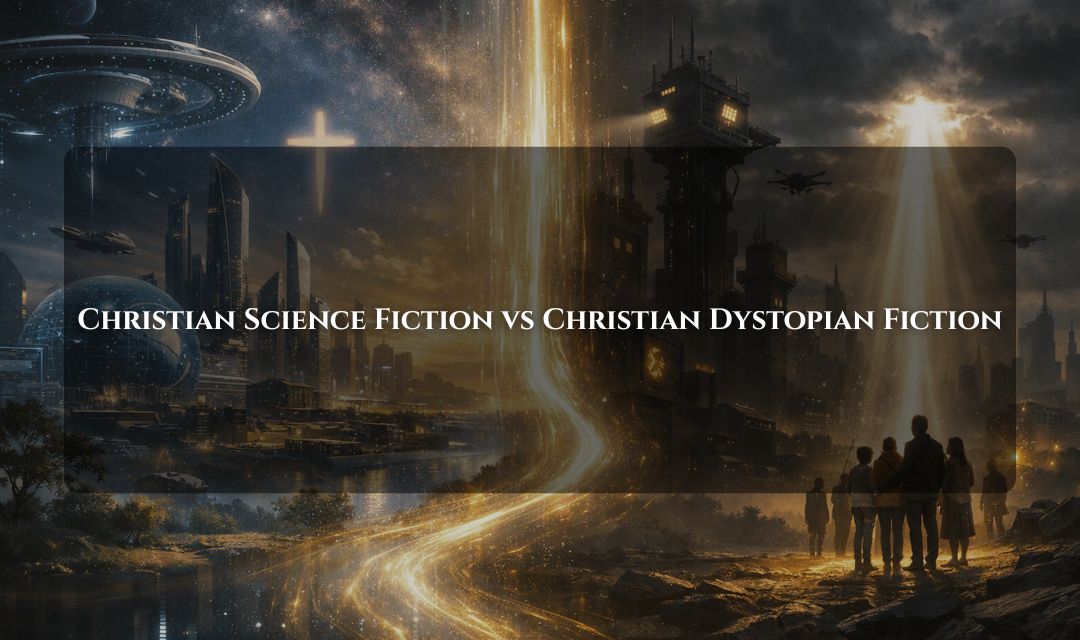
Christian Science Fiction vs Christian Dystopian Fiction
Although these genres overlap, their primary focus is different.
| Features | Christian Science Fiction | Christian Dystopian Fiction |
| Main Focus | Scientific discovery and future technology | Society under oppression or collapse |
| Central Conflict | Balancing innovation with faith | Remaining faithful during persecution |
| Typical setting | Space colonies, future Earth, advanced civilizations | Controlled governments, ruined societies, authoritarian regimes |
| Technology | Often explored as possibility and responsibility | Frequently used for surveillance and control |
| Spiritual Themes | Stewardship, ethics, creation, purpose | Endurance, hope, sacrifice, spiritual warfare |
Do These Genres Overlap?
Absolutely.
Many modern novels blend both genres into one compelling story.
For example, a novel may begin as classic Christian science fiction with revolutionary technology that promises a better world. As that technology becomes a tool for global control, the story gradually shifts into Christian dystopian fiction.
This combination allows authors to explore both scientific imagination and biblical prophecy while maintaining a strong faith message.
Stories involving artificial intelligence, digital identity systems, global governments, or advanced surveillance often cross between these two genres naturally.
Which Genre is Right for You:
As a reader, you always want to unlock as many aspects of reading as possible. Choosing between these genres depends on the type of story you enjoy most.
You may prefer Christian science fiction if you enjoy:
- Exploring future inventions
- Space adventures
- Scientific discoveries
- Questions about ethics and technology
- World-building and futuristic societies
You may enjoy Christian dystopian fiction if you like:
- High-stakes survival
- Spiritual courage under pressure
- End-times themes
- Government conspiracies
- Stories about hope in dark times
If you’re interested in both technology and biblical prophecy, you’ll likely appreciate novels that combine elements of both genres.
A Novel That Bridges Both Worlds
Some books intentionally combine the strengths of both genres. Sealed for the Lamb: The Last Resistance is one example.
The novel begins with advanced neural technology, artificial intelligence, and a highly connected futuristic society, hallmarks of Christian science fiction. As the story unfolds, that same technology becomes a system of spiritual oppression under the Dominion, creating a dystopian world where believers must resist deception, remain faithful, and place their hope in Christ.
Its blend of futuristic innovation, biblical symbolism, persecution, and spiritual resistance illustrates how Christian science fiction and Christian dystopian fiction can work together to create a powerful faith-centered narrative.
Final Thoughts
Understanding Christian science fiction vs Christian dystopian fiction helps readers choose stories that align with both their interests and their faith.
Christian science fiction invites readers to imagine the future through the lens of biblical wisdom, asking how believers should respond to scientific advancement and innovation. Christian dystopian fiction, on the other hand, challenges readers to consider how faith endures when truth is rejected, freedom is threatened, and hope seems distant.