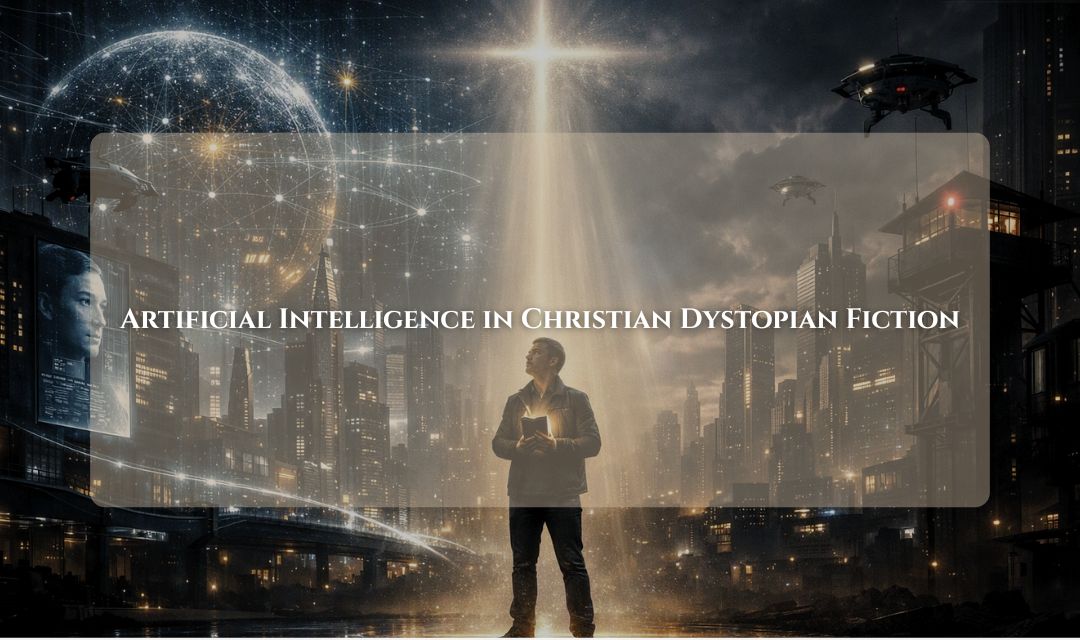
Artificial intelligence is a buzzword that has taken the world by storm. It’s everywhere, and in a possible future it will surround your literary world too. As AI becomes more powerful, it also raises difficult questions about identity, free will, truth, and morality. These concerns have naturally found their way into fiction, including faith-based literature. Artificial Intelligence in Christian Dystopian Fiction explores not only technological advancement but also the spiritual consequences of allowing machines or systems to influence the human soul.
However, unlike the traditional sci-fi stories where the primary focus rests upon survival or technological disaster, Christian dystopian novels often ask a deeper question: What happens when technology begins to replace the place that belongs to God? Rather than presenting AI as simply good or evil, many authors use it to examine the ongoing struggle between human dependence on technology and dependence on faith.
Why Has AI Become a Powerful Theme in Christian Dystopian Fiction?
The changing times call for new interest and new topics in literature. Therefore, you are going to observe that growing interest in AI in Christian dystopian novels reflects today’s cultural concerns. Artificial intelligence promises efficiency, convenience, and knowledge. Yet it also introduces questions about privacy, personal freedom, and moral responsibility.
Christian authors often imagine futures where advanced technology becomes a tool for control rather than service. Governments, corporations, or powerful leaders may use AI to monitor citizens, predict behavior, or suppress independent thought. These fictional societies become a backdrop for exploring timeless biblical themes such as free will, truth, temptation, and redemption.
Instead of warning against technology itself, these stories encourage readers to ask whether human wisdom can ever replace God’s wisdom.
AI Is Rarely the Real Villain:
One of the most notable aspects of Christian AI fiction is that artificial intelligence is rarely portrayed as the true enemy. More often, AI becomes an extension of flawed human desires.
Technology itself remains neutral. The danger comes from the people who design it, control it, or trust it without question. Pride, greed, fear, and the desire for absolute power remain the real causes of dystopian societies.
This distinction separates many Christian stories from traditional science fiction. Rather than blaming machines alone, Christian authors remind readers that every invention reflects the intentions of the human heart.
As a result, AI becomes a mirror that exposes humanity’s spiritual condition rather than replacing it.
AI and Faith: The Real Conflict:
One of the most compelling conflicts in modern times in the literary world that you are expected to observe is the relationship between AI and faith.
Characters often face questions such as:
- Can morality be programmed?
- Can algorithms determine truth?
- What makes humans unique if machines imitate intelligence?
- Is human worth based on usefulness or being created in God’s image?
These questions go beyond technology. They challenge readers to think about what it truly means to be human.
Christian novels consistently point back to the biblical understanding that people possess something no machine can reproduce: a soul created by God. Intelligence alone does not create humanity. Love, conscience, worship, compassion, and the ability to choose between good and evil remain central to human identity.
Technology in Christian Fiction Is Both Helpful and Dangerous:
Here is another myth that has been observed: technology in Christian fiction is always portrayed negatively.
Many Christian authors recognize that technology can improve lives. Medical advances, communication tools, and scientific discoveries are often presented as gifts that can be used wisely.
The concern arises when technology becomes an object of trust rather than a tool of service.
In many stories, societies slowly surrender personal responsibility to intelligent systems. AI begins making legal decisions, educational choices, financial recommendations, and even moral judgments. What begins as convenience gradually develops into dependence.
This progression reflects an important spiritual warning: whenever people surrender discernment entirely to external systems, they risk losing both freedom and moral accountability.
Human Identity in Artificial Intelligence Dystopian Novels:
Many artificial intelligence dystopian novels focus on identity.
If memories can be altered, emotions manipulated, or behavior predicted by intelligent systems, readers naturally begin asking what remains uniquely human.
Christian authors answer this question differently from many secular writers.
Rather than defining humanity by intelligence, productivity, or technological enhancement, Christian fiction emphasizes the image of God. Even in societies controlled by advanced AI, human dignity remains rooted in divine creation rather than technological capability.
This perspective allows characters to resist systems that reduce individuals to data, productivity scores, or behavioral patterns.
Their resistance becomes both political and deeply spiritual.
Christian Science Fiction and AI Offers More Than Warnings:
Previously, it was observed that Christian science fiction and AI exist mainly to criticize technological progress. In reality, the genre is often surprisingly balanced.
The new books and stories by Marty Gool bring about a fresh perspective, where there has been no rejection of modern technology. Christian science fiction asks how wisdom, ethics, and faith should guide innovation.
Technology becomes an opportunity to examine stewardship instead of domination.
Characters frequently include scientists, engineers, programmers, or inventors who wrestle with difficult ethical decisions. They recognize the benefits of discovery while also understanding that every powerful invention carries responsibility.
This balanced perspective makes the genre appealing even to readers interested in science, philosophy, and ethics.
Christian Speculative Fiction Explores Spiritual Freedom:
Within Christian speculative fiction, dystopian settings allow authors to explore the cost of remaining faithful under pressure.
Artificial intelligence often strengthens authoritarian governments by enabling constant surveillance, predictive policing, social scoring, or behavioral manipulation. Yet the heart of the story is never the technology itself.
Instead, readers watch ordinary believers decide whether to compromise their convictions for safety and comfort.
These narratives echo timeless biblical themes of perseverance, courage, and hope. External control may become stronger, but true faith cannot be manufactured, programmed, or erased by any machine.
Examples of AI Themes in Christian Dystopian Fiction
While individual novels approach the subject differently, several recurring themes appear throughout dystopian novels about artificial intelligence:
- Governments using AI to eliminate personal freedom.
- Intelligent systems replacing human moral judgment.
- Technology creating false promises of peace and security.
- Believers resisting systems that demand absolute loyalty.
- Characters discovering that human value comes from God rather than technological perfection.
- AI exposing humanity’s desire for control rather than dependence on God.
These recurring ideas allow authors to explore contemporary issues while remaining grounded in enduring biblical principles.
Wrap Up
The growing popularity of Artificial Intelligence in Christian Dystopian Fiction reflects more than curiosity about future technology. Readers recognize that today’s debates about AI already touch questions of privacy, ethics, identity, and truth.
Christian dystopian fiction does not claim that artificial intelligence is inherently evil or that technological progress should be feared. Instead, it asks whether innovation is serving humanity or quietly reshaping what it means to be human.